Digital logic

Propositional or boolean logic:
Basically logics are of two types; propositional logic and predicate logic. Proposition is an assertion which is either true or false but cannot be both at same time.
Eg:
1. 3+4=7
2. 19 is a prime number
3. Earth is rectangular in shape

In this statement 1 and 2 are proposition but 3rd is not bcoz it's false statement. This is assertion not proposition and this is called linear paradox.
Basic logic operations on proposition:
1.)Conjunction: Let p and q are two propositions.Conjunction is described by a word " and" . Truth table for and gate is:
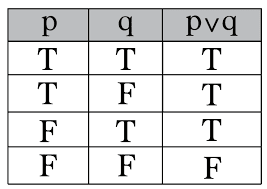
  2. Disjunction: it is described by "or" . Truth table for or is:
3. Negation: It is represented by tilde ~. Truth table is:
4. Implication: Represented by =>.                     


Comments

Popular posts from this blog

Hub, repeater, switch, router, gateway, bridge

HUB Hub is a controller that controls the traffic on the network.  The following important properties of hub are:  1) It amplify signals. 2) It propagates signals through the network. 3) It does not require filtering. 4) It does not require path determination for switching. 5) It is used as network concentration points. Hubs are basically two types: 1) Active hub 2) Passive hub Active hub: A ctive hub works as repeater which is a hardware device that regenerates the received bit pattern before sending them out . Passive hub : A passive hub is a simple hardware device which provide a simple physical connection between the attached devices. Advantages of hub: It cannot filter the traffic full stop feeling generally refers to a process or device that screens network traffic for certain characteristics such as source address and destination address and protocol. Disadvantages of hub: On a hub, more than one user may try to send data on the netwo...

Generalization and Specialization

Generalisation is an abstraction for sharing similarities among classes while preserving their differences. For example, each piece of equipment has a manufacturer weight and cost . Pumps also have suction pressure and flow rate. Tank also have volume and pressure we would like to define equipment features just once and then add details for pump, tank and other equipment types. Generalisation is a relationship between a class and one or more refined versions of it. The class being refined is called superclass and each refined version is called a subclass. For example equipment is the superclass of pump and tank. Attributes and operations common to a group of subclasses are attached to the superclass and shared by each subclass. Each subclass is set to inherit the feature of its superclass, for example, pump inherites attributes manufacturer, weight and cost from equipment. Generalisation is sometimes called the "is-a" relationship because each instance of a subclass is ...

OOP's( Object Oriented programming)

The object oriented approach views off problem in terms of objects involved rather than procedure for doing it. Object oriented program names is defined as a method of implementation in which programs organised are cooperative collections of objects, each of which is an instance of some class. The following general concept of oops are: 1) Object 2) Class 3) Data abstraction 4) Data encapsulation 5) Polymorphism 6)  Dynamic binding 7) Message passing 8) Inheritance 1) Object :  Object is an entity that can Store send and receive messages and an instance of a class. Each object contains both data and code to manipulate the data objects can interact without having to know details of each objects Data and code. For eg: person, place and table etc. 2) Class :  A class is a collection of objects that share common properties and relationships. For example you can think of a buses as objects. They have characteristics like steering wheel, motor, ...